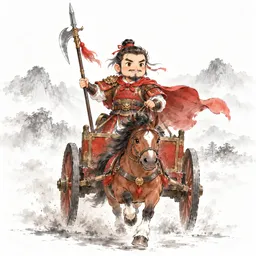
In xiangqi, the cannon moves just like a chariot: any distance in a straight line. But it captures in a very special way: there must be exactly one piece between it and its target, as if it were firing over that piece. The piece in between is called the screen (炮架, pào jià), and it can belong to either side. Each side has two cannons. There is no equivalent piece in Western chess.
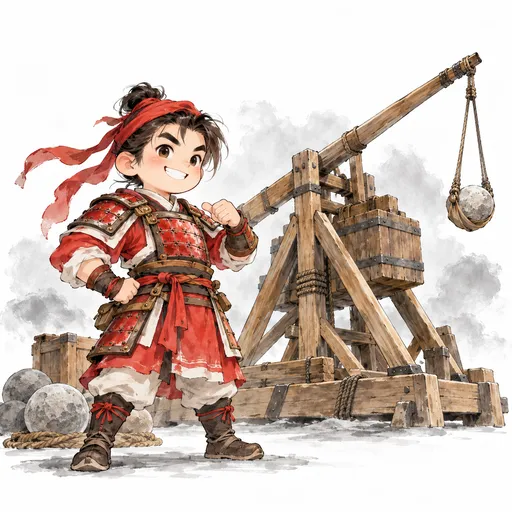 炮
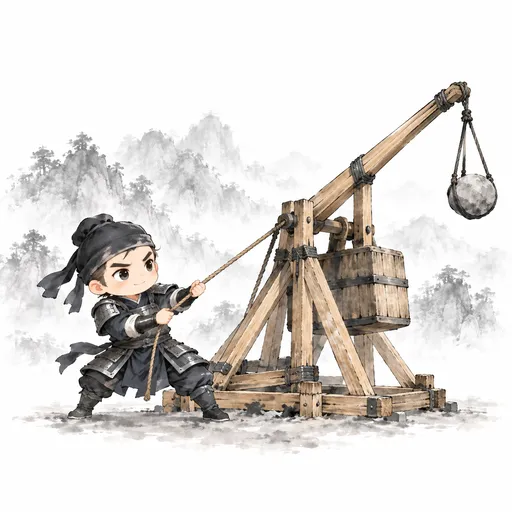 砲
Names and origin
Red writes 炮 and Black writes 砲; simplified sets use 炮 for both. One character has the "fire" radical (火), the other the "stone" radical (石), but they move in exactly the same way.
The two characters hide a story. One account says that the early 砲 was a stone-throwing machine: a long arm with a counterweight that flung large rocks at city walls. A thrown stone has to clear whatever is in front of it to hit its target — which is exactly the "capture over one piece" rule. Gunpowder cannons came much later, and only then did the fire-radical 炮 appear on the pieces. That is why the cannon on this site is drawn as an engineer with a trebuchet.
How it moves: like a chariot
When it is not capturing, a cannon is simply a chariot: choose up, down, left or right and slide along the line, stopping wherever you like, as long as nothing is in the way.
The screen: capturing over one piece
To capture, there must be exactly one piece between the cannon and its target — no more, no fewer. Without a screen, it can't take even an enemy piece right next to it; with two pieces in between, it can't fire over them either.
The most common beginner mistake is treating the cannon like a chariot and trying to take a piece right next to it. Remember: it walks like a chariot but captures by jumping a hill.
Opening: the Central Cannon
The cannon is the most aggressive piece in the opening. Red's most popular first move is to slide a cannon to the middle file, the Central Cannon (中炮). In WXF notation this is C2=5:
Once the central cannon is in place, Red's cannon, Red's central soldier, Black's central soldier and the black general all stand on one file, and Black has to respond. The most common reply is to jump a horse out to guard the central soldier — the "Screen Horses" described on the horse page.
How much is a cannon worth? Why it weakens in the endgame
A common rule of thumb is cannon about 4 points, roughly the same as a horse (chariot 9, soldier 1). But the cannon's value depends heavily on the position:
- Opening and middlegame: the board is full of pieces, there are screens everywhere, and a cannon can strike from a long way off.
- Endgame: with few pieces left, the cannon often can't find a screen, has nothing to capture, and is weaker than a horse.
That is why experienced players often prefer to keep a horse rather than a cannon going into the endgame.
Checkmating with the cannon
Because a cannon needs a screen to give check, the defender can not only block but also remove the screen, or add a second piece so the cannon can't fire through. The two classic cannon mates shut down both ideas:
Double Cannon mate (重炮): two cannons on the same file, the front one acting as the screen for the one behind.
Smothered Palace mate (悶宮): the general is boxed in the middle of its palace by its own two advisors, and a cannon checks from straight ahead over one piece. The general can't move at all.
Cannons also mate together with horses — most famously the "Horse and Cannon" mate, with the horse in front taking away escape squares and the cannon checking from behind it. See the horse page.
Frequently asked questions
Can a cannon capture a piece right next to it?
No. A cannon always needs exactly one piece in between to capture. A piece right next to it has no screen, so the cannon can neither capture it nor move onto that point.
Can the screen be an enemy piece?
Yes. The screen can be your own piece or your opponent's — it just has to be exactly one piece.
Can a cannon capture over two pieces?
No. There must be exactly one piece in between. Zero or more than one, and it can't fire.
What is the difference between 炮 and 砲?
Red writes 炮 and Black writes 砲; they move in exactly the same way. Simplified sets use 炮 for both sides.
Can the cannon cross the river?
Yes. The cannon has no territory limits and moves the same way on both sides of the river.
Try it yourself
The best practice is to play a game opening with the Central Cannon and see how the computer responds. Play xiangqi online against the computer: when you select a cannon, the board shows where it can move, pieces it can capture get a dashed ring, and targets without a screen don't appear. To see all seven pieces, go back to Xiangqi pieces; compare it with the similar chariot, or return to the xiangqi home page.