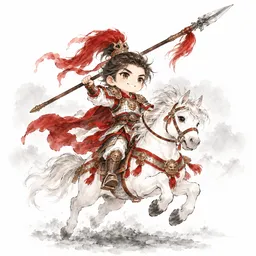
In xiangqi, the chariot moves in a straight line, up, down, left or right, as many points as it likes, as long as nothing is in the way. If the first piece in its path belongs to the opponent, it may capture it and stop there. It moves exactly like the rook in Western chess. The chariot is the strongest piece in the game, and each side has two.
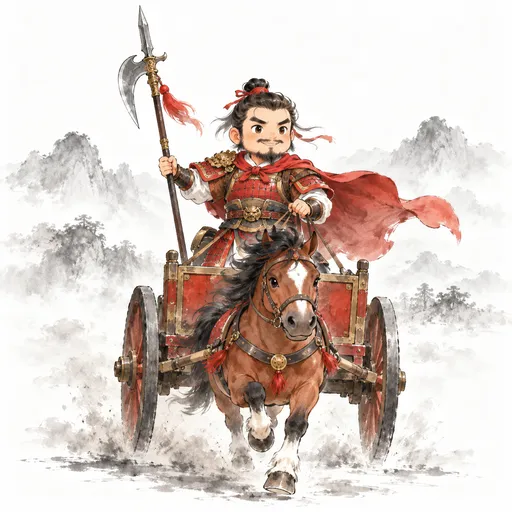 俥
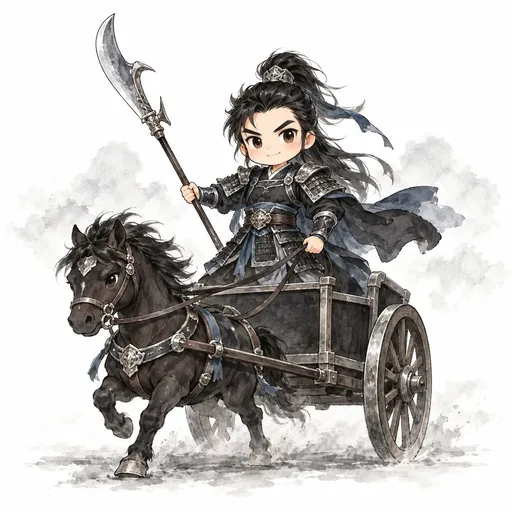 車
Names and origin
Red's chariot is written 俥 and Black's 車; simplified sets write both as 车. As with the horse, the two characters only help you tell the sides apart — the moves are identical.
When used for the chess piece, the character 車 is traditionally read jū (as in the phrase 車馬炮, "chariot, horse, cannon") rather than the everyday chē. It stands for the war chariot of ancient battles: pulled by horses, carrying warriors with long weapons, charging straight in — exactly how the piece behaves on the board.
How it moves: straight lines, any distance
Choose a direction — up, down, left or right — and slide along the line as far as you like. The chariot has no territory limits: it can cross the river, retreat and move sideways.
Count them: five up, four down, four left and four right. In an open position a single chariot controls a whole file and a whole rank, and that is where its strength comes from.
Stopping when blocked
The chariot cannot jump over pieces. If it meets one of your own pieces, it must stop before it; if it meets an enemy piece, it may capture it and stop on that point — but it can go no further.
How the chariot captures
The chariot captures in the simplest possible way: slide along the line and take the first enemy piece you meet. So any enemy piece standing on the same line as a chariot, with nothing in between, is in danger.
How much is a chariot worth?
A common rule of thumb is chariot 9 points — a bit more than a horse plus a cannon (about 4 each; a soldier is 1). So trading a chariot for a horse or a cannon is usually a bad deal, unless the trade leads straight to checkmate or wins back more material.
The chariot is strongest in open positions: once its lines are clear, one chariot watches many points at once. On the other hand, a chariot shut in its corner by its own pieces is worth almost nothing.
Openings: get the chariots out early
At the start the chariots sit in the corners, hemmed in by their own horses and elephants. An old saying goes "if your chariot isn't out in three moves, you've already half lost the game" (三步不出車,棋已輸一半). In other words, within the first few moves you should give your chariots a way out; otherwise you are playing without your strongest piece.
The most common way is to move the horse out of the way first, then slide the chariot across:
Keep one idea in mind in the opening: you move the horses and cannons largely so the chariots can come out. The earlier and more smoothly they arrive, the more initiative you have.
Checkmating with the chariot
A chariot gives check along a straight line and often works together with the other rules to leave the general with nowhere to go. Two of the most common patterns:
Facing Generals mate (白臉將, also called 對面笑, "laughing face to face"): the two generals may never face each other on an open file. The chariot checks from one side, and the general can't sidestep because that file is covered by the opposing general.
Double Chariot mate (雙車錯): one chariot controls the row in front of the general while the other checks along the general's row, so it can go neither forward nor sideways.
In real games the two chariots often take turns giving check, driving the general step by step to the back rank. With both chariots still on the board, your mating chances are much higher.
Frequently asked questions
Can the chariot cross the river?
Yes. The chariot has no territory limits and moves the same way on both sides of the river.
Can the chariot move several points at once?
Yes, any number of points, stopping wherever you like — it just can't jump over pieces in its way.
What is the difference between 俥 and 車?
Only the character: Red writes 俥 and Black writes 車. They move in exactly the same way. Some sets use 車 for both and rely on the colour.
Why is 車 pronounced "jū"?
By tradition the chess piece 車 is read jū, as in 車馬炮. People will understand chē, but players rarely say it that way.
Is the chariot stronger than the horse and the cannon?
Yes, it is the strongest piece, usually valued at 9 points, while the horse and cannon are about 4 each. One chariot is roughly worth a horse plus a cannon.
Try it yourself
The best practice is to play a game focusing on your two chariots: get them out within the first few moves. Play xiangqi online against the computer — when you select a chariot, every point it can reach lights up. To see all seven pieces, go back to Xiangqi pieces; compare it with the very different horse and cannon, or return to the xiangqi home page.