In xiangqi, the elephant moves exactly two points diagonally: its start and end points are opposite corners of the character 田 (a 2×2 block of squares), which is why players say "the elephant walks 田". The point in the middle of the 田 is called the elephant's eye, and if anything stands on the eye, the elephant can't move that way. The elephant can never cross the river and stays home as a defender. Red writes 相 and Black writes 象; each side has two.
 相
 象
Names
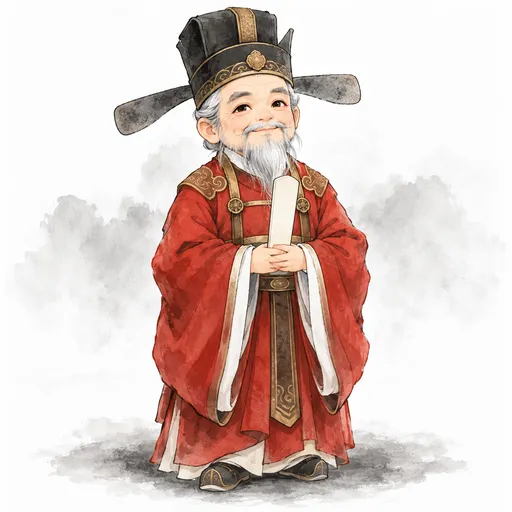
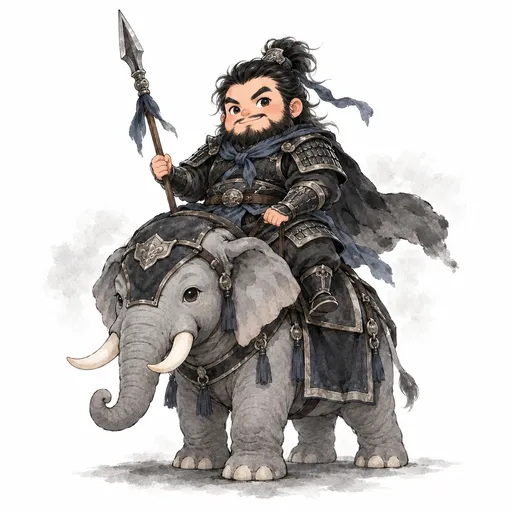
Red writes 相 (xiàng) and Black writes 象 (xiàng); simplified sets use the same characters. They sound alike and move alike, but mean different things: 相 is a chancellor or chief minister, the civil official who runs things from the rear, while 象 is an elephant — one account says it comes from the war elephants of ancient battlefields. The pictures on this site follow the characters: Red is an old chancellor holding a court tablet, Black is a warrior riding a war elephant.
Chancellor or elephant, the job on the board is the same: stay at home and protect the general.
The 田 move: up to four points
The elephant moves in the four diagonal directions, always exactly two points, jumping across a 田. From the middle of its territory it can go all four ways.
An elephant can't move just one point diagonally, and it never moves straight. The most common beginner mistake is treating it as a piece that can slide diagonally anywhere.
Blocking the elephant's eye
The point in the middle of the 田, between the start and the end, is the elephant's eye. If any piece — yours or your opponent's — stands on the eye, the elephant can't move in that direction. In Chinese this is 塞象眼 (sāi xiàng yǎn). It works just like hobbling the horse.
Opponents often put a piece on an elephant's eye on purpose to freeze it; when you arrange your own pieces, take care not to block your elephants in.
The elephant can't cross the river
The elephant may only move on its own side. An elephant standing by the river can't go in either direction across it.
That is why the elephant, like the advisor and the general, is a home defender: it simply has no way to attack the other side.
Only seven points, ever
Because it always moves two points diagonally and can't cross the river, an elephant can only ever stand on seven points. Learn these seven and you'll never misplace an elephant, and you'll always know where it can go next.
Two elephants standing where they protect each other (for example one in the centre and one on the back rank) are called connected elephants (相連), the most solid defensive shape.
Its value: without elephants, beware the cannon
A common rule of thumb is elephant about 2 points, about the same as an advisor. It can't cross the river and has almost no attacking power, but without it the general's defence gets much weaker.
One of the elephant's most important jobs is to act as a shield in front of the general, depriving enemy cannons of convenient screens. Players say "without elephants, fear the cannon" (缺相怕炮):
On the other hand, elephants don't handle horses well: a horse can turn corners and often lands on points the elephants can't cover. Defending against horses needs the advisors and the general too.
Opening: the Elephant Opening
Opening by moving an elephant to the centre is called the Elephant Opening (飛相局). It doesn't rush to attack: it first secures the centre and then sees what the opponent does — a very solid way to play.
After the elephant comes to the centre it can watch both sides at once, and if the opponent sets up a central cannon, the elephant is already standing in front of the general.
Frequently asked questions
Can the elephant cross the river?
No. The elephant stays on its own side; from the riverbank it can't move in either direction across.
What does "blocking the elephant's eye" mean?
When the elephant moves two points diagonally, the point in between is its eye. If any piece, yours or the opponent's, is on the eye, the elephant can't move that way.
What is the difference between 相 and 象?
Only the character: Red writes 相 and Black writes 象. They move in exactly the same way.
Can the elephant move just one point diagonally?
No. One point diagonally is how the advisor moves; the elephant always moves exactly two.
Should I trade my elephants early?
Usually not. Elephants are core defenders, and without them your general is very exposed to the opponent's cannons. Keep them unless you can trade for something more valuable.
Try it yourself
Play a game and try to keep your two elephants on points where they protect each other, then watch whether the opponent's cannons can find a screen. Play xiangqi online against the computer — when you select an elephant, blocked directions simply don't light up. Compare it with the horse, which can be blocked in a similar way, or see how the soldier crosses the river, from Xiangqi pieces; to start from the beginning, visit the xiangqi home page.