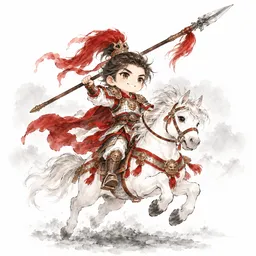
In xiangqi, a soldier moves one point at a time. Before it crosses the river it can only go straight forward; once it is across, it may move forward or sideways, but it can never move backwards. Red's are written 兵 and Black's 卒; each side has five. They are the most numerous and individually the weakest pieces — yet they often decide the game.
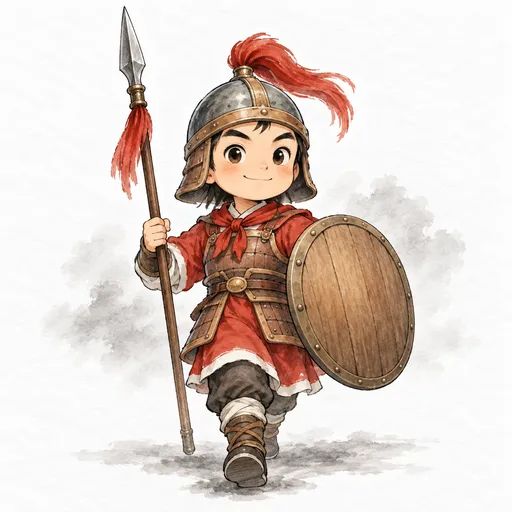 兵
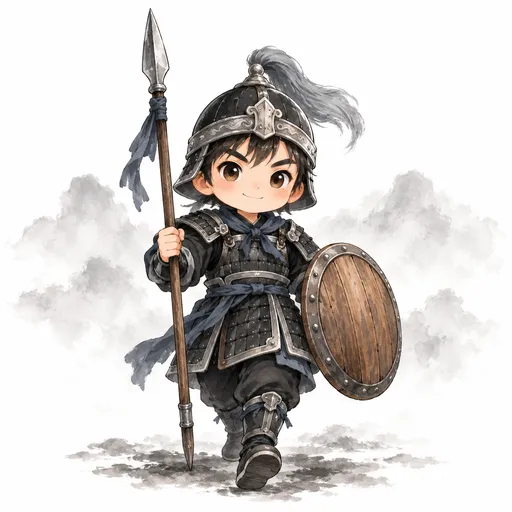 卒
Names
Red writes 兵 (bīng) and Black writes 卒 (zú); simplified sets use the same characters. They move in exactly the same way — the different characters just make it easy to tell friend from foe.
In ancient armies, the infantry marched at the front with spears and shields, advancing step by step. Xiangqi puts the soldiers on the row just in front of the river, the closest any piece starts to the enemy. One account says that soldiers, like chariots, horses and cannons, were added to the game in the Tang dynasty, and that the set-up matched today's only from the Song dynasty on.
Before the river: one point forward
At the start all five soldiers are on their own side of the river, and they can only move one point straight forward — no sideways moves yet.
That makes soldiers easy to stop early on: put any piece directly in front of one and it can't move.
Across the river: sideways too
Once a soldier reaches the opponent's side, it gains two more directions, left and right — still one point at a time. Moving forward, left or right onto an enemy piece captures it.
A soldier captures in the same direction it moves. That's different from the pawn in Western chess, which captures diagonally — something chess players should watch out for.
A soldier on the last rank: sideways only
Because a soldier can't move backwards, once it charges all the way to the opponent's back rank it has only the two sideways moves left. Xiangqi soldiers never promote.
So pushing a soldier as deep as possible isn't always best. A soldier one or two rows in front of the enemy palace (a "high soldier", 高兵) controls the general's escape squares and is far more useful than one that has reached the end.
How much is a soldier worth?
A common rule of thumb is soldier 1 point, 2 once it has crossed the river; a chariot is about 9, and a horse or cannon about 4 each.
In the opening soldiers aren't worth much and are often traded to open lines for the horses and chariots. In the endgame, as the board empties, a soldier across the river becomes very valuable: it can approach the enemy palace and help the general deliver mate. In endgames, one extra soldier is often the difference between winning and losing.
Opening: the Pawn Opening
Opening with a soldier push is called the Pawn Opening (仙人指路, "the immortal points the way"): Red pushes the third- or seventh-file soldier one point, opening a path for the horse while waiting to see Black's reply.
The advantage of pushing a soldier is that you don't commit to a set-up yet, and your horse gets a wider path out. When Black replies with the matching soldier push, it is called the "Two Soldiers" game (對兵局).
Checkmating with soldiers
On their own soldiers are weak, but together with the general they are dangerous. If your general stands on a neighbouring file, the enemy general can't step onto that file (the generals may not face each other), so in effect your general controls a whole row of escape squares.
The endgame plan is simple: push a soldier up to the palace, then place your general on a neighbouring file, and the enemy general has very few places to hide.
"A soldier across the river"
"A soldier who has crossed the river can only go forward, never back" (過河卒子,有進無退) is a very common saying in Chinese. It began as a plain description of the rule, and is now used for anyone who has burned their bridges and must keep pushing ahead.
Another common phrase is 拱卒 (gǒng zú), "nudging the soldier forward" — advancing soldiers one careful step at a time. On the board, a steady soldier advance is often worth more than a rush to the far end.
Frequently asked questions
Can a soldier move backwards?
No. Whether or not it has crossed the river, a soldier can never move back.
When can a soldier move sideways?
After it crosses the river onto the opponent's side. On its own side it can only move forward.
Does a soldier promote when it reaches the last rank?
No. Xiangqi has no promotion. A soldier on the last rank stays a soldier and can only move sideways.
Does a soldier capture diagonally, like in chess?
No. A xiangqi soldier captures in the direction it moves: straight ahead before the river, and ahead or sideways after it.
What is the difference between 兵 and 卒?
Only the character: Red writes 兵 and Black writes 卒. They move in exactly the same way.
Try it yourself
The best practice is to play a game where you try to get one soldier safely across the river and then use it with your general to hunt the enemy general. Play xiangqi online against the computer — select a soldier and the board shows where it can go. To see other pieces, such as the horse that can be hobbled, go back to Xiangqi pieces; to start from the beginning, visit the xiangqi home page.