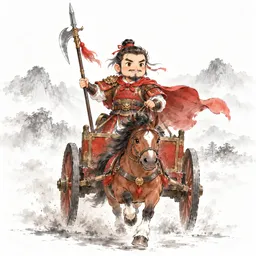
In xiangqi, the general (帥 for Red, 將 for Black) moves one point up, down, left or right inside the palace. It can't move diagonally and can't leave the palace. There is also a rule found only in xiangqi: the two generals may never face each other on the same file with nothing in between. The whole game revolves around this piece — checkmate the opposing general and you win.
 帥
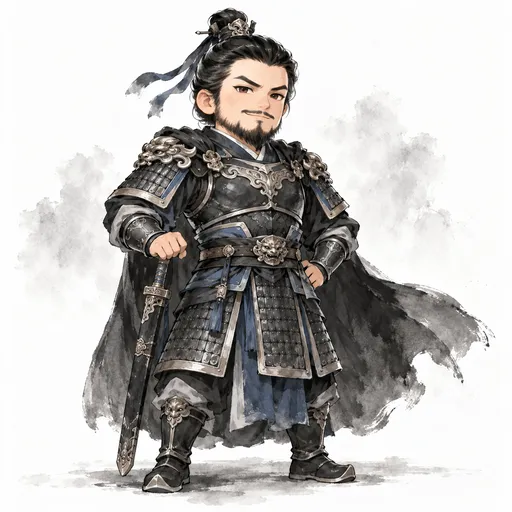 將
Names and origin
Red writes 帥 (shuài, "marshal") and Black writes 將 (jiàng, "general"); in simplified Chinese they are 帅 and 将. They move in exactly the same way. In English the piece is usually called the General or the King. When a player says 將軍 (jiāng jūn), it means "check" — "I'm coming for your general".
One story says the red and black armies are Liu Bang and Xiang Yu in the war between Chu and Han, and that the "Chu River, Han Border" (楚河漢界) written across the middle of the board is the gorge that once separated their armies. Another says the game was invented by the general Han Xin in his army camp. These are old tales and may not be true, but they give every game the feel of two armies facing off. What is more certain is that today's form — the general seated in the palace, 32 pieces in all — was settled around the Song dynasty.
How it moves: one point straight inside the palace
The general moves one point up, down, left or right each turn, and only within the nine points of the palace. From the centre of the palace it has four moves; in a corner, only two.
The generals may not face each other
If the two generals stand on the same file with no pieces at all between them, they are said to "face each other" (照面), and that is not allowed. This is often called the flying general rule. It means:
- A general can't move onto a file where it would face the enemy general.
- When only one piece stands between the two generals, that piece can't leave the file, or the generals would face each other.
It looks like a restriction, but in practice it is a powerful weapon: without moving at all, a general controls its whole file and keeps the enemy general off it.
Check must be answered
If an enemy piece could capture your general on its next move, you are in check. When in check, you must get out of it this move, and there are only three ways:
- Move the general to a point where it can't be captured.
- Block: put a piece between the checking piece and the general (against a horse, block its leg; against a cannon, change its screen).
- Capture the checking piece.
You can't ignore a check, and you can't make a move that leaves your own general in check — on this site, just as under the official rules, such moves never even appear among the points you can choose.
Checkmate and stalemate both lose
If you are in check and none of the three answers works, it is checkmate, and you lose. The pattern below is called the Facing Generals mate (對面笑, also 白臉將): the red general holds the central file, so the black general can only go forward, where the chariot is waiting.
There is another way to lose that many people don't know: if you are not in check but have no legal move on your turn, it is called stalemate (困斃, kùn bì), and it is also a loss. This is different from Western chess, where stalemate is a draw — in xiangqi, stalemate loses.
Its value, and attacking in the endgame
The general has no point value: if it is checkmated you lose, so it can never be traded. But it isn't only something to protect. In the endgame, with fewer pieces on the board, the general can be a big help:
- Thanks to the facing rule, a general standing on a file seals it off against the enemy general.
- When your soldiers reach the enemy palace, your general backing them up on the file stops the enemy general from coming over to take them.
The Facing Generals mate above is an example: the red general never moves — it just stands in the middle, and that is enough to help the chariot trap the black general.
Frequently asked questions
Can the general move diagonally?
No. The general only moves one point up, down, left or right; the piece that moves diagonally inside the palace is the advisor.
Can the general leave the palace?
No. The general spends the whole game inside its own palace, moving among its nine points.
What happens if the generals face each other?
Such a move is simply illegal. On this site, points that would make the generals face each other never light up, so you can't play them.
Why is stalemate a loss?
The xiangqi rule is "if it's your turn and you have no legal move, you lose", whether or not you are in check. This is different from stalemate in Western chess, so chess players should take special note.
Can I give check forever (perpetual check)?
No. If one side checks on every move and the position keeps repeating, the checking side must change its play, or it loses.
Try it yourself
The best practice is to play a game and try to hold a file with your general while your chariot finishes the job. Play xiangqi online against the computer: when you're in check, your general glows red and only the moves that escape the check light up. To see the other pieces, go back to Xiangqi pieces; to start from the beginning, visit the xiangqi home page.